
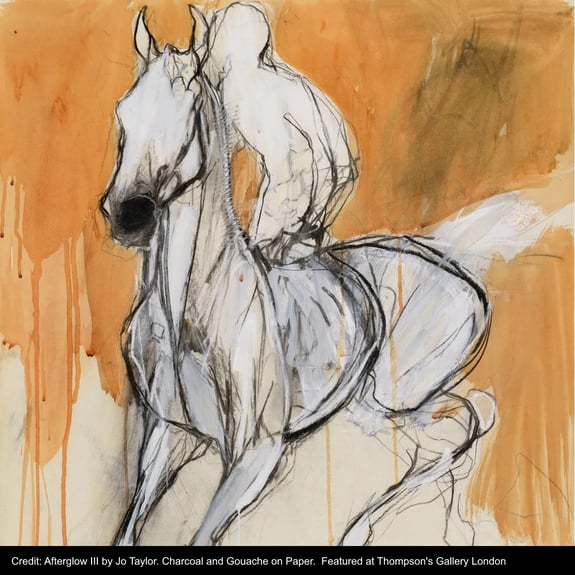
There is a quiet but profound moment that happens when an artist’s work leaves the studio and enters the world. It is no longer just paint on canvas or charcoal on paper. It becomes a statement, a story, a presence that must hold its own in a gallery, in a collector’s home, and increasingly, in printed form.
For the recent project featuring artist Jo Taylor at Thompson’s Gallery, Healeys Printers were entrusted with a responsibility that goes far beyond ink and paper. They were asked to translate art into print without losing its soul.
This is not a routine print job. It is a discipline, a craft, and in many ways, an extension of the artistic process itself.

The Role of Print in the Art World
In an era dominated by screens, printed material might seem secondary. Yet in the art world, print holds a unique and enduring authority.
A printed book or catalogue is not just a marketing tool. It is:
-
A permanent record of an exhibition
-
A tactile representation of an artist’s body of work
-
A collectible object in its own right
-
A bridge between the gallery and the wider world
Digital images can approximate artwork, however the experience of holding a beautifully crafted and produced book defines a personal relationship between artist and beholder . The weight of the paper, the depth of colour, the sharpness of detail, and even the subtle sheen of the ink all contribute to how the work is perceived.
For collectors and enthusiasts, these printed pieces often become as cherished as the artworks themselves.
The Challenge: Translating Art into Print
Reproducing fine art in print is one of the most technically demanding disciplines in the printing industry. Unlike commercial print, where slight variations may go unnoticed, art reproduction operates under a far stricter standard.
Every detail matters.

Colour Accuracy
Colour is the most obvious and most unforgiving element. A slight shift in tone can completely alter the emotional impact of a piece.
Blues that should feel cool and contemplative can become flat or lifeless. Warm tones can drift into oversaturation. Subtle gradients can collapse into harsh transitions.
For the Jo Taylor project, achieving colour fidelity meant:
-
Careful calibration across every stage of production
-
Close collaboration between printer and gallery
-
Iterative proofing to ensure accuracy under real-world lighting conditions
The goal is simple in principle but complex in execution: the printed page must reflect the original artwork as faithfully as possible.
Detail and Texture
Beyond colour lies detail. Fine brushwork, delicate linework, and layered textures all contribute to the character of an artwork.
Print must capture:
-
The nuance of mark-making
-
The interplay of light and shadow
-
The depth that gives a piece its presence
This requires high-resolution imaging, precision plate-making, and meticulous press control. Any compromise here risks flattening the work, stripping it of the qualities that make it distinctive.

Material Matters
Paper is not just a substrate. It is part of the experience.
The choice of stock influences:
-
How colours are perceived
-
How light interacts with the page
-
The tactile feel of the finished piece
For an art book, the paper must strike a careful balance.
Too glossy, and it can feel commercial. Too matte, and it may mute the vibrancy of the work.
Similarly, binding plays a crucial role. Techniques such as case binding, often used for premium art books, provide durability and a sense of permanence. They also allow the book to open beautifully, ensuring that images are presented without distortion or loss across the spread.
Why Galleries Still Rely on Print
For a gallery like Thompson’s, reputation is everything. Every detail of how an artist is presented contributes to that reputation.
A printed book serves several critical purposes:
Extending the Exhibition
-
An exhibition is temporary. A printed catalogue is not.
-
It allows the work to live on beyond the gallery walls, reaching collectors, institutions, and audiences who may never visit in person.
-
Reinforcing Credibility
A beautifully produced book signals seriousness and intent. It tells the viewer that the work matters, that it has been given the attention and respect it deserves.
This is particularly important for emerging or featured artists. The quality of presentation can influence perception, and perception often shapes value.
Creating a Tangible Connection
Art is inherently tactile, even when viewed behind glass. Print restores some of that physical connection.
Holding a book, turning its pages, and engaging with the work in a quiet, personal space creates a different kind of relationship with the art.
It becomes intimate, considered, and lasting.
Healeys Printers: Precision as a Philosophy
The social post from Healeys captures something essential: when galleries place their trust in a printer, the expectation is absolute.
There is no margin for error.
What sets this kind of work apart is not just technical capability, but mindset. The principles that underpin successful art reproduction are the same principles that define exceptional print more broadly:
-
Control over every variable in the production process
-
Consistency from first proof to final run
-
Attention to detail at a level that borders on obsessive
-
These are not optional extras. They are the foundation.
For Healeys, the ability to meet the demands of gallery reproduction is not a niche skill. It is proof of a standard that applies to every project they undertake.
The Wider Implication for Brands
While this project centres on fine art, the implications extend far beyond the gallery.
Any brand that invests in print is, in effect, asking for the same things:
-
Accurate representation
-
Consistent quality
-
A finished product that feels as good as it looks
If a printer can meet the uncompromising standards of art reproduction, they bring that same discipline to corporate brochures, product catalogues, and marketing materials.
The difference is not in the process, but in the stakes. And when the stakes are highest, the process must be flawless.
Print as a Statement of Intent
In a world where speed and convenience often take priority, choosing to produce a high-quality printed piece is a deliberate act.
It says:
-
This work is worth preserving
-
This brand values craftsmanship
-
This message deserves more than a fleeting glance
For Jo Taylor’s showcase at Thompson’s Gallery, the printed book is more than documentation. It is part of the exhibition’s legacy.
It carries the work beyond the gallery, into homes, collections, and conversations. It ensures that the art is not just seen, but remembered.
Closing Reflection
There is a tendency to think of printing as a final step, a means to an end. Projects like this challenge that assumption.
When done at the highest level, print becomes part of the creative outcome. It shapes how work is experienced, understood, and valued. For artists, galleries, and brands alike, the lesson is clear. Presentation is not separate from substance. It is inseparable from it.
And when that presentation is handled with precision, care, and complete confidence, it does more than represent the work.
It elevates it.