

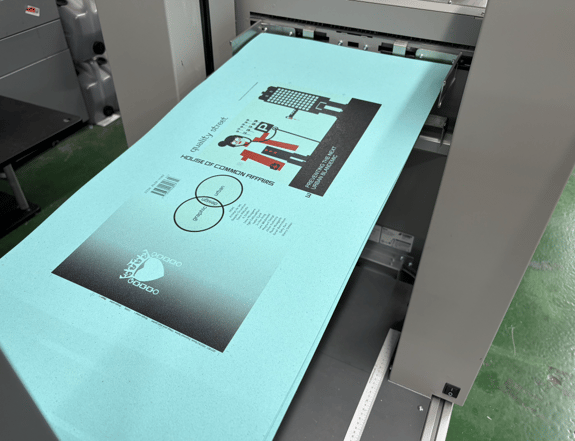
Planning a print project needs a great brief. Planning to include all your sustainable specifications needs the right partner.
A sustainable specification for print goes beyond price and deadlines. With more pressure to deliver measurable outcomes alongside cost efficiency, quality and supplier performance, do your sustainable goals suffer? Do you feel you need to compromise sustainability for price?
Whether you are planning a major marketing campaign, your annual report, exhibition catalogues or something simple, the print specification you create has a direct impact on environmental performance, carbon reporting and supply chain transparency.
Most print briefs still focus almost entirely on price and turnaround time. Healeys can help you consider how you can achieve sustainable goals, what questions to ask your print experts and why Healeys have already invested to ensure you are able to achieve the very best in every print project.
Whether you are looking to start your sustainable production journey by reducing sustainable print impact or have specific Scope 1, 2 or 3 targets, starting with the right brief is a step in the right direction. With much to assess and to avoid 'greenwashing', working with a printer who has already established the processes, reporting and standards is a great place to start.
Firsts for sustainability
As one of the first Carbon Balanced Printers in the UK and the first SME printer to have their Science Based Targets (SBTi) recognised, we know the key areas every business and buying team should include when preparing a sustainable print brief or tender - and how choosing the right print partner can significantly improve both environmental and commercial outcomes.
We’ve created our Sustainable Print Guide to help guide and ask the right questions for your next project.
Why sustainable print buying matters
Sustainability is no longer a “nice to have” in any business. It is now central to supplier selection, tender evaluation and corporate governance for many companies - and even if you're a business without this in place, majority of companies prefer to make better choices for production where they can.
At the same time, there are still widespread misconceptions about print and paper. Research from Two Sides and the Love Paper campaign continues to demonstrate that paper, when responsibly sourced and properly recycled, is one of the most sustainable communication mediums available.
Did you know?
- European forests are growing by the equivalent of 1,500 football pitches every day (Two Sides)
- Paper has one of the highest recycling rates of any material in Europe, with recycling rates exceeding 70% (Two Sides)
- Paper is renewable, recyclable and naturally biodegradable, subject to the printing processes it goes through (Love Paper)
- FSC® and PEFC certification schemes ensure fibre is sourced from responsibly managed forests (staging2.twosides.info)
The real sustainability challenge how print is specified, produced, distributed and recycled.
Working with our clients, we are able to explore different ways to achieve sustainable success. Here one of our clients shares a fantastic project where the carbon footprint was carefully measured.
What teams should include in a sustainable print brief
1. Clear sustainability objectives and planned outcomes
Start by defining what sustainability means for your business and your next project.
This could include:
- Reducing emissions through production choices
- Supporting SBTi commitments your business has already made
- Improving recyclability and using certified materials
- Eliminating unnecessary waste, particularly in the outer packaging used for transit
- Removing plastics where possible
- Improving lifecycle reporting, carbon measurement
- Supporting circular economy principles such as whether the items you are producing are for single use or must be recyclable in mainstream processes,
The clearer the objectives, the easier it becomes for your print partner to recommend the right production route.
2. Paper specification
Paper selection has one of the biggest influences on the environmental impact of print. However, sustainable procurement is not simply about choosing “recycled paper.” The right specification can balance aspects such as recycled content and what is most suitable for your project:
- Whether you prefer to use FSC® or other paper standards
- Requirements for uncoated or recyclable substrates
- Restrictions on laminates or mixed materials
- End-of-life recyclability
Research from Two Sides shows that paper fibres are reused multiple times within the recycling process and that paper remains one of the strongest examples of a circular economy material. (staging2.twosides.info)
As a knowledgeable print partner, Healeys will also advise when recycled stocks are appropriate and when responsibly sourced virgin fibre may actually provide better environmental and functional outcomes for a project.
3. Carbon measurement and reporting requirements
This is one of the most overlooked sections in print buying. If your business reports against SBTi targets or broader ESG commitments, your print partner should be able to provide meaningful carbon data, not vague sustainability claims.
Buying teams should ask:
- Can the supplier provide project-level carbon calculations?
- Are Scope 1, 2 and 3 emissions measured?
- Is reporting independently verified?
- What about annual sustainability reporting?
- Are carbon reduction targets in place?
- Where relevant, are those targets aligned with SBTi principles?
Many suppliers claim sustainability credentials, but few have independently validated emissions reduction pathways. This is where supplier selection becomes critical and the field can narrow as few UK printers can meet this criteria – Healeys is one of only a few.
4. Supplier accreditation and environmental standards
Environmental certifications should never be treated as a tick-box exercise. They provide procurement teams with evidence that sustainability systems and processes are embedded operationally. With Healeys, the investment over the years has developed
- Carbon reduction strategies
- Renewable energy usage
- Waste reduction processes
- FSC® Chain of Custody Certification
Healeys has in place a range of actions across the business reducing impacts, recycling and re-using materials where possible.
5. Production methods and waste reduction
The way a project is produced can dramatically influence its environmental impact. An effective sustainable brief should encourage every to recommend the most efficient production route, including:
- Lithographic vs digital print efficiencies
- Waste reduction methods, optimised sheet sizes, reduced makeready waste
- Lower production methods
This is why procurement teams benefit from working collaboratively with experienced print partner early in the planning process. Good print buying is not simply about buying ink on paper. It is about designing a more efficient manufacturing process from the outset.
6. Distribution, Logistics and Fulfilment
Transport emissions often form a major part of print-related Scope 3 emissions. When considering how to reduce the 'last mile' in production, Healeys will advise on how to achieve lower impacts where possible:
- Delivery locations where there are consolidation opportunities to reduce journeys
- Mailing and fulfilment expectations planned in advance to reduce packaging and waste
- Carbon-conscious logistics preferences
Forward-thinking print suppliers can reduce environmental impact significantly through smarter fulfilment strategies and consolidated distribution.
7. End-of-Life and recyclability
Sustainable print procurement should consider what happens after the product has been used. By deciding at the start with the end in mind, it can signal clearly to the recipients what they can do with the items you have produced.
By showing clearly if an item can be recycled at home or whether it needs to be placed into more specialist recycling can close the loop – and tell your customers and clients how you actively support sustainable initiatives.
Not every print process is fully recyclable so this stage of your briefing is important.
- Is the item being fully recyclable once printed?
- Are coatings or laminates recyclable?
- Is the packaging being used for distribution recyclable or compostable?
- Are there opportunities to design for reuse?
Simple specification changes can dramatically improve recyclability without compromising visual impact.
Why the right print partner matters
A sustainable print specification is only as effective as the print partner delivering it. The best print partner does more than simply quote a job. Healeys help procurement, buying and marketing teams make better environmental decisions, reduce waste, improve reporting and align print activity with wider ESG objectives.
Healeys: supporting sustainable print
Healeys has built sustainability into every stage of its print production and operational strategy. Healeys have already committed to a 42% reduction in carbon emissions by 2030 against a 2020 baseline. Healeys operates with renewable energy initiatives, supporting carbon balanced print through the World Land Trust. With a pledge to reduce operational emissions year on year, Healeys are tireless in their pursuit of great production. It is why so many businesses trust Healeys to work collaboratively with them on important sustainability projects.
For businesses and teams seeking a print partner capable of supporting both creative excellence and measurable sustainability outcomes, Healeys provides the expertise, transparency and environmental leadership required for modern print procurement.
Sustainability matters
Buying your print sustainably is no longer simply about choosing recycled paper.
It is about creating intelligent specifications that reduce environmental impact, support measurable carbon reduction, improve supply chain transparency and deliver genuinely effective printed communications.
The clients achieving the strongest sustainability outcomes are those working closely with Healeys, who are advising strategically, reporting transparently, investing and innovating to achieve the best outcomes. By building sustainability into the print brief from the very beginning, organisations can ensure they deliver print which performs commercially, creatively and environmentally.
And with Healeys, your print can remain one of the most powerful - and sustainable -communication channels available today.
To book a meeting, call back or to simply explore more about Healeys work, click here.
